Lynchburg Tennessee: The Tiny Tennessee Town Where Jack Daniel’s Was Born - And Why It Feels Frozen in Time

I was originally planning to spend the day visiting small towns around Nashville. No real plan, just driving and stopping wherever looked interesting. At some point, I took a turn I didn’t mean to take—and that’s how I ended up in Lynchburg.
At first, it didn’t feel like anything special. Just a quiet Southern town with a courthouse, a few shops, and not much going on. I almost kept driving, but something about it made me slow down. It felt calm in a way that didn’t seem staged or designed for visitors.
Then I started noticing the signs.
Jack Daniel’s.
Once you see it once, you start spotting it everywhere—on windows, on walls, on little details you wouldn’t even think about otherwise. That’s when it clicked. This wasn’t just another small town. This was the place behind something I had seen all over the world.

Lynchburg: A Town That Quietly Stayed the Same
Lynchburg, Tennessee was established in the early 1800s, and unlike many towns that expanded or modernized over time, it stayed remarkably consistent. It never grew into a city, never developed into something fast-paced or commercial, and never tried to compete with nearby places like Nashville.
The town grew around agriculture, local trade, and the courthouse square, which still serves as the center of everything today. That square hasn’t been redesigned to feel historic—it simply never changed much to begin with. The buildings around it reflect that. They’re not polished or reimagined for tourism. They feel original, functional, and lived in.

Walking through Lynchburg, you don’t get the sense that you’re in a preserved destination. You get the sense that you’re in a place that continued its life without interruption. Even when the Jack Daniel’s distillery started gaining international recognition, the town itself didn’t shift to match it. It didn’t expand or try to turn into something bigger. It stayed grounded in what it had always been.
That’s what makes it stand out. Not because it’s trying to be different, but because it never changed in the first place.
Jack Daniel: A Life That Didn’t Start the Way You’d Expect
The story of Jack Daniel feels less like a typical business origin story and more like something that developed gradually, through circumstances that weren’t particularly planned.
Jasper Newton Daniel was born in the mid-1800s, although even his exact birth date isn’t entirely certain. Records from that time weren’t always precise, and that alone gives his story a slightly unclear beginning.
His early life wasn’t easy. His mother died when he was young, and his relationship with his father was strained. Eventually, he left home and ended up working for a Lutheran preacher named Dan Call. What makes that interesting is that Dan Call also ran a distillery, and that’s where Jack first learned how to make whiskey.
He didn’t learn in a formal setting. He learned by being around it, observing, and working closely with people who already understood the process. One of those people was Nathan “Nearest” Green, who is now recognized as a key figure in teaching him the craft. That part of the story adds another layer, because it shows that what became Jack Daniel’s wasn’t built in isolation.
Jack was very young when he started his own distillery—some accounts say he was still in his teens. It’s hard to imagine someone that young building something that would eventually become so widely known, but that’s exactly what happened.
At the time, it was just a small operation in a small town. There was no indication that it would grow into anything beyond that.
How Jack Daniel’s Became Global Without Leaving Lynchburg
What makes this story more interesting is that the brand didn’t grow by relocating or scaling somewhere larger. It grew by staying exactly where it started.
The natural resources in Lynchburg played a big role in that. The cave spring water in the area is naturally filtered through limestone, which removes iron and creates a cleaner base for whiskey. That water source is still used today, and it’s one of the main reasons production never moved elsewhere.
Then there’s the process itself. Instead of going straight from distillation to aging, the whiskey is filtered slowly through charcoal. It’s not the fastest method, but it produces a smoother result, and that became the defining characteristic of Jack Daniel’s.
Over time, that combination—location, process, and consistency—made the brand recognizable far beyond Tennessee. It expanded globally, reaching bars, restaurants, and stores across the world.
But Lynchburg didn’t expand with it.
That contrast is what makes the place feel so unusual. Something globally recognized is still being produced in a town that feels almost unchanged.
It’s interesting to see how something made in a place this small can become globally recognized, and I had a similar feeling when I was exploring wine culture in Porto, where tradition and location play just as big of a role.
The Details That Make the Story Feel Real
There are a few things about Jack Daniel that stand out because they don’t fit the typical narrative.
He never married and didn’t have children, which was unusual for that time. Instead, he passed the distillery on to his nephew, Lem Motlow, who played a major role in expanding the business.
Then there’s the story of how he died. It’s one of those details that feels almost too simple to be true, but it is.
He couldn’t remember the combination to his safe one morning, got frustrated, and kicked it. That injury turned into an infection, and eventually, it led to his death. It’s such a small, almost random moment, but somehow it ended up defining the end of his life.
Visiting Jack Daniel’s Tomb
The cemetery where Jack Daniel is buried is quiet and simple, just outside the center of town. There’s nothing overly marked or designed to draw attention—it feels like a normal place rather than a tourist stop.
His tomb is surrounded by an iron fence, but what stood out most to me were the two chairs placed directly in front of it. They’re positioned in a way that makes it clear people don’t just pass through here. They sit.

You can easily imagine someone bringing a bottle, pouring a glass, and spending a few minutes there. There were bottles left nearby, which made that even more believable. It didn’t feel staged or curated. It felt like something people actually do.
That detail made the experience feel more personal. Not like visiting a landmark, but like being in a space where people come to acknowledge something quietly.
Seeing the Distillery (Even Without the Full Tour)
I arrived a little later than planned, so I didn’t get to do the full distillery tour, which was disappointing at first. But even just seeing the buildings and stepping inside briefly gave me a good sense of what it’s like.
The setting is not what you’d expect. It’s surrounded by trees and open land, not industrial structures. It feels connected to the landscape, which makes sense considering how important the water source is.

Inside, the structures feel traditional. You can see the wooden elements, the barrels, and the layout that reflects a process that hasn’t been redesigned just for efficiency. It doesn’t feel overly modern, and that seems intentional.
Even without seeing the full production process, you can tell that consistency matters more than change here.
One Thing I Didn’t Expect About Lynchburg, Tennessee
One thing that surprised me about Lynchburg is that it’s located in a dry county.
That means you can’t just walk into a regular grocery store or gas station in town and buy alcohol like you normally would. There aren’t standard liquor stores around the way you’d expect, and alcohol sales are still limited because of local laws.
What makes it interesting is that the Jack Daniel’s Distillery still operates here.
The reason is that the distillery existed before many of the current restrictions, and over time, exceptions were made because it’s such an important part of the local economy. Today, visitors can buy certain bottles directly at the distillery, especially commemorative or specialty ones that aren’t sold everywhere else. Tastings are also allowed in a controlled setting as part of the tour experience.
So even though it’s technically a dry county, it’s not completely alcohol-free. It’s just regulated differently.
It’s a bit unusual, but once you understand how the rules work, it makes more sense.
What to See in Lynchburg (Besides the Distillery)
Even though Lynchburg is small, there’s actually more to do than just the distillery. It’s not a place where you rush from one attraction to another, but if you slow down a bit, there are a few spots that are definitely worth checking out.
The town square is the starting point for everything. It’s simple, centered around the courthouse, and honestly one of those places where you just walk without a plan. The buildings around it feel original, not redesigned, and that’s what makes it interesting. Nothing feels overly polished or staged.
Right near the square, you’ll find the old jail, which has been turned into a small museum. It’s not huge, but it gives you a glimpse into what life in a town like this used to look like. It’s one of those places you can step into quickly but still walk out feeling like you learned something.
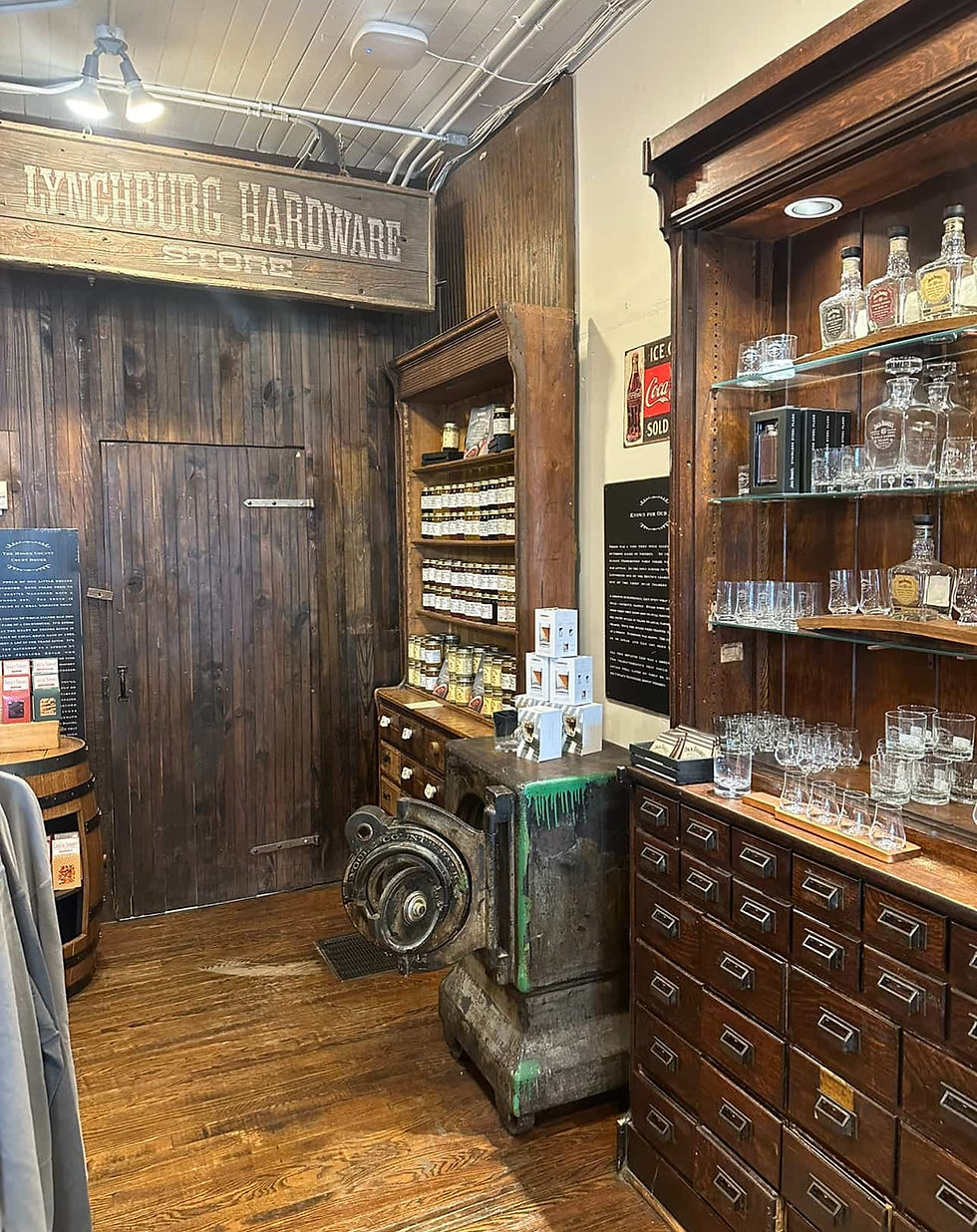
Then there are the Jack Daniel’s shops, which you really can’t miss. Some of them are more traditional souvenir stores, but others have that slightly old-school general store feel. You’ll find everything from classic bottles to branded merchandise, and even if you’re not planning to buy anything, it’s worth stepping inside just to see how much of the town revolves around it.
If you didn’t get to do the full distillery tour (like me), it’s still worth walking around the grounds and seeing the buildings up close. The setting alone is interesting—surrounded by trees and open space, not what you’d expect from something so globally known.
And then there’s something I didn’t expect at all—Jack Daniel’s pie. Yes, that’s actually a thing here. It’s rich, a little indulgent, and very on-brand for the town. Even if you’re just curious, it’s worth trying once.
Overall, Lynchburg isn’t about having a long checklist of things to do. It’s more about walking, noticing, and letting the town reveal itself a little bit at a time.
Is Lynchburg Worth Visiting?
It depends on what you’re looking for. If you want a full itinerary with multiple attractions, it might not meet that expectation.
But if you’re exploring Tennessee and want to stop somewhere that feels different without trying too hard to be, then it’s worth it.
It’s funny how some of the most iconic drinks come from places that feel completely unexpected—whether it’s a quiet town in Tennessee or the tropical island where the piña colada was created.

Where to Stay in Lynchburg
Lynchburg is small, so there aren’t many places to stay right in town, but that’s part of the experience. Most options are simple, local, and close to everything.
(Some of the links below are affiliate links, which means I may earn a small commission if you book through them—at no extra cost to you.)
This is the most convenient option if you want to stay right in town. It’s within walking distance of the square and just minutes from the distillery, so you don’t really need to drive once you’re there. It’s not luxury, but it’s clean, comfortable, and practical for a short stay. 👉
If you want something more personal, this is a small bed and breakfast that feels more like staying in someone’s home. It’s quiet, a little more charming, and fits the overall vibe of Lynchburg really well. 👉
This one is a bit outside of town, but it’s definitely more unique. It’s set on a farm, so it feels peaceful and a little different from a typical hotel stay. If you want something more scenic and slower-paced, this is a good option. 👉
Final Thoughts
I didn’t expect much from Lynchburg. It wasn’t even on my list, and I almost didn’t stop. But somehow, it ended up being one of those places that stays in your mind longer than it should.
Maybe it’s the contrast—a tiny, quiet town connected to something known everywhere. Or maybe it’s just the feeling that nothing here is trying too hard.
Either way, I left with that song playing in my head—“smooth as Tennessee whiskey”—on repeat the whole drive out.
Cheers 🥃


Comments